
How do you measure AI visibility?
You measure AI visibility by checking whether your brand appears in relevant AI answers, which competitors appear instead, which sources are cited, and whether the answer presents your business positively, neutrally or not at all.
That sounds simple, but in practice it gets messy very quickly.
In my experience, one prompt tells you almost nothing.
One AI answer on one day might mention your company. Another answer, using a slightly different question, might ignore you completely and recommend three competitors instead.
That is why I do not measure AI visibility with a single “Do I appear in ChatGPT?” test.
I look for patterns.
Those patterns can include:
- brand mentions
- cited sources
- competitor presence
- answer share
- sentiment
- query coverage
- source frequency
- whether your business is recommended for the right use cases
- which pages or third-party sources AI systems seem to rely on
At Found First, we have built internal tools and workflows to test this at scale as part of our SEO & GEO Visibility Audits. Manual checks are still useful, but once you start testing dozens or hundreds of prompts, you need a more structured way to record what is actually happening.
Why traffic alone no longer tells the full story
Traditional SEO measurement often focuses on rankings, clicks and organic traffic.
Those metrics still matter.
But they no longer tell the whole story.
According to SparkToro / Similarweb data, 68.01% of U.S. Google searches ended without a click in the first four months of 2026.
That does not mean search visibility is less important. It means the measurement has changed.
A potential customer might see your brand in an AI summary, compare you in a generated answer, read your reviews, notice a competitor mentioned more often, and only later decide who to contact.
You may influence the decision before the click ever happens.
That is why AI visibility measurement needs to include mentions, citations, answer share, sentiment, query coverage and competitor presence – not just rankings and traffic.
Source: SparkToro / Similarweb, June 2026
Test the right queries
The biggest mistake I see is testing only the brand name.
That might tell you whether an AI system knows who you are.
But it does not tell you whether you appear when a potential customer is making a decision.
I usually test questions like:
- “best provider for…”
- “agency for…”
- “how to choose…”
- “alternatives to…”
- “who can help with…”
- “best company for [service] in [location]”
- “which provider is best for a small business?”
These are the kinds of questions that can shape a shortlist.
They are also the questions where competitors often appear before you realise there is a visibility gap.
Track query fan-out and cited sources
A good measurement process should look at the sources AI systems appear to rely on.
Are they citing directories?
YouTube?
Review sites?
Competitors?
Comparison pages?
Forums?
News articles?
Your own website?
This is where the work gets interesting, because the same few sources often appear again and again across different prompts.
In my experience, those repeated sources are often more useful than the answer itself.
They show you where authority is being built, where competitors are being supported, and where your own business might be missing from the evidence layer. I suggest reading more about query fan-out here, I think it’s an incredibly important part of understanding GEO (or modern SEO).
Tools for measuring AI searches and citations
There are paid tools that measure AI results, and some are useful.
But I also like using free sources where possible.
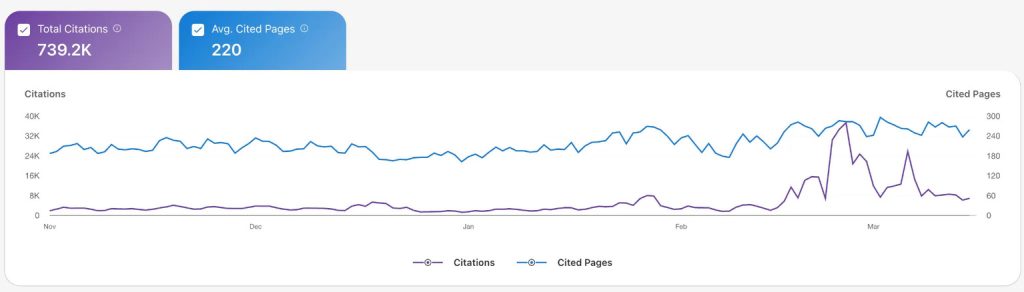
One tool I recommend watching is Bing Webmaster Tools, especially where AI citation data is available. I use it myself because it gives a more concrete view of whether content is being cited, not just whether a tool says your “AI visibility score” is high or low.
That said, no single tool gives the full picture.
The best results usually come from combining:
- manual prompt testing
- citation checks
- competitor analysis
- source tracking
- Google Search Console data
- Bing Webmaster Tools
- content gap analysis
- query fan-out checks
That is the difference between a useful AI visibility review and a vanity score.
Why this matters commercially
AI visibility is not just another marketing metric.
If AI tools recommend competitors before users ever visit Google, your business may lose leads without seeing the lost traffic in analytics.
That is why I treat AI visibility as part of the wider search journey.
The real question is not just:
“Are we getting traffic?”
It is:
“Are we being found, understood and trusted in the places where decisions are being shaped?”
For more context, visit the wider AI Visibility FAQ. If you need a structured view of your current AI visibility, you can have your AI visibility measured through the SEO & GEO Visibility Audit.